
Inside Elmwood’s work to reimagine Dolmio’s beloved puppet family, balancing nostalgia, distinctive brand assets and modern relevance.
For established brands, heritage is one of their most valuable assets. Decades of familiarity can build recognition, emotional connection and a place in consumers’ lives that new brands spend years trying to establish. But as audiences, cultures and channels evolve, even the most iconic brands face a challenge: how do you stay relevant without losing what made you distinctive in the first place?
It’s a question at the heart of heritage brand revitalisation, and one Elmwood explored in bringing back Dolmio’s much-loved puppet family for the brand’s 40th anniversary.
After a decade away, Papa, Mama, Sophia, Carlo, Nina and Nico have returned, reimagined for a new generation. The challenge wasn’t simply to recreate a familiar piece of advertising history, but to transform the characters into a contemporary brand asset, capable of building connection across culture, content and commerce.
Why distinctive brand assets matter in heritage brand revitalisation
First introduced as handcrafted puppets in 2003, the Dolmio family became a defining part of the brand’s identity.
Through the much-loved When’s your Dolmio Day? campaign, the characters brought to life the noisy, loving chaos of family mealtimes, helping turn an everyday pasta sauce into something associated with togetherness and shared rituals.
Their personalities, relationships and familiar appearances made them more than advertising mascots. They became distinctive brand assets, carrying years of accumulated recognition and emotional meaning.
But nostalgia can be a double-edged sword. Reintroducing a familiar character without evolving it risks turning a brand into a tribute to its past. Change too much, however, and the connection audiences have built with it can disappear.
For Dolmio, the opportunity was to build on that existing equity, finding a way for the family to connect with both the audiences who grew up with them and those meeting them for the first time.
How Elmwood modernised Dolmio’s iconic characters
Elmwood’s approach began with identifying the characteristics that made each family member unmistakable.
The familiar silhouettes, expressions and family dynamics remained, while the finer details were carefully reworked to give the puppets a contemporary personality.
From clothing and material choices to skin textures, hair and subtle facial expressions, every element was considered. Even micro-expressions and wrinkles around the eyes played a role in making the characters feel alive.
Drawing on the craft of traditional puppet-making and animation, Elmwood refined the family without sacrificing the warmth and individuality of the originals.
The work also went beyond their physical appearance. Each character was given clear principles, behaviours and visual codes, establishing distinct personalities that could be expressed consistently across different environments.
Rather than delivering a cosmetic refresh, Elmwood developed a more defined character system, one that preserved the qualities audiences recognised while creating new possibilities for how the family could interact with them.
Building a distinctive brand identity system across channels
When the Dolmio family first appeared, their world largely revolved around television advertising. Today, brand characters need to work across a much broader range of consumer experiences, from social content to the retail shelf.
For Elmwood, this meant integrating the family into Dolmio’s wider brand identity, rather than treating them as standalone campaign mascots.
Central to the approach was Dolmio’s distinctive red dot graphic system. Individual characters can appear within the dot, while the whole family can take centre stage in moments celebrating food and togetherness.
This gave the brand a coherent visual language with the versatility to accommodate different characters, messages and formats.
Working closely with T&P, Elmwood developed the system for use across paid, shared, earned and owned channels. The characters needed to create emotional moments in advertising, participate in culturally relevant social content and provide a recognisable connection to Dolmio at the point of purchase.
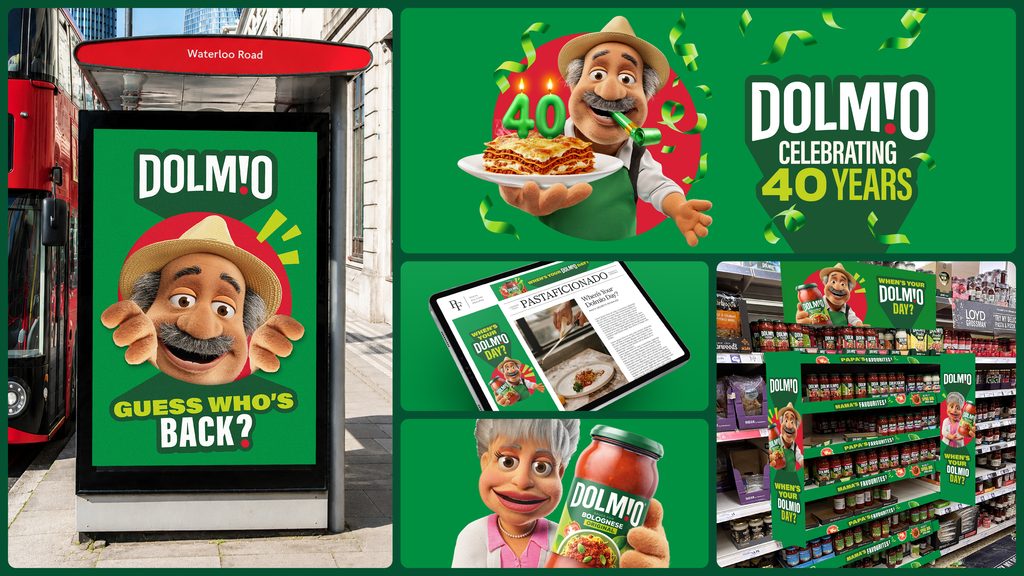
Their role was therefore both emotional and commercial: to entertain and engage audiences while supporting the brand’s presence throughout the consumer journey.
The project illustrates how distinctive character design can become an integrated part of a brand’s communications and shopper experience, rather than remaining confined to individual advertising executions.
Balancing human creativity with digital production
The return of Dolmio’s puppet family also reflects a wider conversation about the role of craft in an increasingly digital creative industry.
The original characters were handmade, and their tactile qualities were fundamental to their appeal. The texture of their skin, the nuances of their expressions and the imperfections in their movement gave them a warmth that audiences connected with.
For the 40th anniversary, the family was rebuilt digitally, with each frame held to the standard of the handcrafted originals.
Technologies such as Unreal Engine and motion capture offer new possibilities for bringing brand characters to life. The Dolmio Puppetiser experience in Australia, which allows families to transform themselves into puppet characters, demonstrates how these assets can also become participatory brand experiences.
But technology is only as valuable as the creative intention behind it.
As Kyle Whybrow, Executive Creative Director at Elmwood London, discusses in his interview with Creative Bloq, audiences increasingly value creative work that demonstrates craft and intent amid the growing volume of AI-generated content.
The distinction isn’t between analogue and digital creativity. It’s between using technology to serve a strong creative idea and allowing the technology itself to become the idea.
For brands navigating increasingly automated production, the challenge is to harness new capabilities without losing the human qualities that make creative work meaningful.
What heritage brands can learn from Dolmio’s revitalisation
Dolmio’s return demonstrates that heritage brand revitalisation doesn’t always require a new identity. Sometimes, the greatest opportunity lies in recognising the value of existing brand assets and finding new ways to make them work harder.
1. Protect what makes the brand recognisable.
Brand revitalisation doesn’t always require a completely new identity. Familiar characters, visual codes and behaviours can hold years of accumulated meaning. Understanding which elements drive recognition is the first step towards evolving them.
2. Modernise the expression, not the underlying identity.
The most effective approach may be to refine how distinctive assets look, behave and connect with audiences, while preserving the elements that make them unmistakable. For Dolmio, this meant retaining the family’s recognisable personalities while updating their craft, characterisation and versatility.
3. Design brand assets for the environments they need to inhabit.
A distinctive asset should be able to work beyond the channels in which it first became famous. Building a flexible identity system allows brands to extend their recognisable elements across advertising, social content, shopper experiences and emerging platforms.
Ultimately, the value of nostalgia lies in its ability to connect past and present.
For Dolmio, parents who remember the puppet family can rediscover familiar characters, while younger generations encounter them through new formats and experiences.
By combining the emotional equity of an established brand with a contemporary, adaptable identity system, Elmwood has helped give Dolmio’s iconic family a role beyond its original advertising legacy.
Because the strongest brand revitalisation doesn’t simply bring the past back. It makes what was valuable about the past relevant to the future.
Read the full interview with Kyle Whybrow, Executive Director at Elmwood London: “Nostalgia is a double-edged sword”: how Dolmio revived its beloved puppet family for a new generation, by Natalie Fear, Creative Bloq.